The September 15 Estimated Payment: Your Safe Harbor Checkpoint for a Calm December
2026-08-10 · 5 min read · estimated taxes
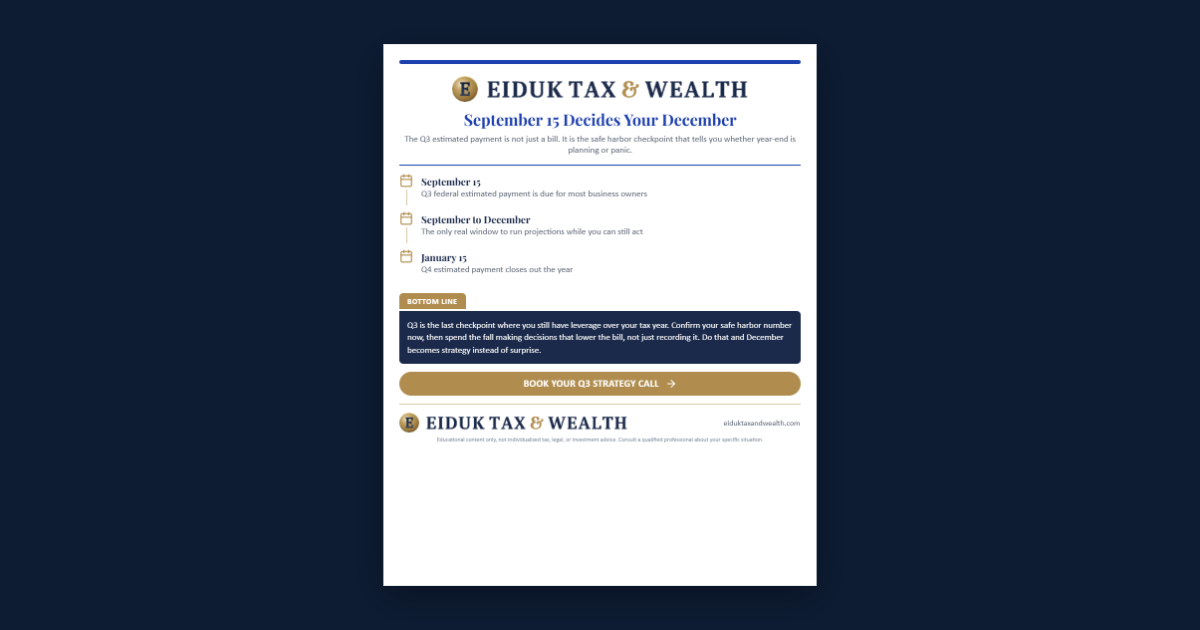
The Q3 estimated payment due September 15 is your safe harbor checkpoint. Here is how to use it to plan year-end instead of scrambling to fix it.
Open your calendar and count the checkpoints left
Look at the months between now and when you file. For most business owners, there are only two estimated payment dates left this year: September 15 and January 15. That is it. Two moments where the IRS checks in, and only one of them still leaves you room to change the outcome.
September 15 is not just another bill to pay. It is a checkpoint that quietly decides which version of your year-end you get. One version is proactive planning, where you run the numbers, make a few smart moves, and lower what you actually owe. The other is a penalty scramble, where you find out in April what happened and pay for it. The date does not change. Which version you get is up to you.
What safe harbor actually means
Safe harbor is the rule that shields you from underpayment penalties. In plain English, if you pay in enough during the year through estimated payments and withholding, the IRS will not charge you a penalty even if you still owe a balance at filing. You have met the minimum.
For most people, safe harbor means paying at least 90 percent of this year's tax, or 100 percent of last year's tax, whichever is smaller. If your adjusted gross income was over $150,000 last year, that second number rises to 110 percent of last year's tax. Hitting one of those thresholds keeps the penalty off your back.
Here is the part people miss. Safe harbor protects you from penalties. It does not lower your actual tax. Meeting safe harbor and lowering your bill are two different jobs. September 15 is when both come into focus at the same time, because you finally have three quarters of real numbers to work with instead of guesses.
Why missing or underpaying costs more than you think
The IRS underpayment penalty is not a flat fee. It works like interest on the amount you were short, and it compounds daily until you pay. The rate is tied to federal interest rates and has sat around 8 percent recently. That is not a rounding error. On a five-figure shortfall, it adds up over the months between the missed deadline and your filing date.
The frustrating part is that this penalty is almost entirely avoidable. It is not a tax on doing poorly. It is a charge for not planning your payment schedule. You can have a great year and still get hit with it simply because the money went in late or came in short.
September to December is your only real window to act
Here is why the Q3 checkpoint matters so much. The stretch from September to December is the last real window to run projections while you can still change the result. You know most of your income. You know your expenses. You have time to make decisions that show up on this year's return, not next year's.
This is when the meaningful moves happen. Funding a retirement plan and confirming which one still allows contributions for the year. Timing an equipment purchase so the deduction lands in the right tax year. Adjusting owner compensation if you run an S corporation. Deciding whether to accelerate or defer income based on where your brackets actually sit. Every one of these changes what you owe, not just what you report.
Contrast that with January 15, the Q4 deadline. By then the year is closed. You are paying the tax the year produced, not shaping it. Almost every strategy move has expired. That is exactly where the penalty scramble lives, and it usually traces back to a Q3 that got ignored.
Planner or payer: which one are you this fall
There are two ways to treat the rest of this year. A payer records what already happened and sends money when the deadline arrives. A planner looks ahead, confirms the safe harbor number, and then spends the fall making decisions that lower the final bill. Same business, same income, very different December.
The difference is not effort or intelligence. It is timing. Wealth is kept by people who make decisions early, not just people who make money. The tax code rewards the founder who runs projections in October far more than the one who reacts in April.
So use the September 15 checkpoint for two jobs at once. First, confirm your safe harbor number so the penalty risk is off the table. Second, treat the payment as your signal to start the year-end planning conversation while there is still time to act. Do that, and December becomes strategy instead of surprise.
Key takeaways
- The Q3 estimated payment is due September 15 for most business owners and is your safe harbor checkpoint.
- Safe harbor means paying at least 90 percent of this year's tax or 100 percent of last year's (110 percent if your prior AGI topped $150,000).
- Meeting safe harbor avoids penalties but does not lower your actual tax; those are two separate jobs.
- September to December is the last window to fund retirement plans, time purchases, and adjust owner comp in ways that change what you owe.
- By the January 15 Q4 deadline, most strategy moves have expired and you are paying, not planning.
Want to confirm your safe harbor number and map the moves that could actually lower your bill before year-end? Reach out to Eiduk Tax & Wealth and let's turn this fall into a plan instead of a scramble.