What a Personal CFO Actually Does (And Why Founders Need One)
2026-07-29 · 5 min read · personal cfo
You have a CPA, an advisor, and a bookkeeper. But who connects them? Here's what a Personal CFO does and why the gaps between them cost you money.
Count the People Managing Your Money
Right now, take a second and count. A CPA who files your return. Maybe a bookkeeper who reconciles your accounts. An investment advisor who manages a portfolio. A payroll company. Possibly an attorney who set up your LLC three years ago and hasn't been heard from since.
That's four or five people touching your money. Now ask a harder question: how many of them talk to each other? For most founders, the honest answer is none. Each one does their job well inside their own lane. Nobody is standing above the whole thing making sure the parts fit together.
That gap is where money leaks. Not through poor effort, and rarely through weak revenue. It leaks through the seams between people who never coordinate. A Personal CFO exists to close those seams.
Historian vs. Architect
Here is a useful way to think about it. Most financial help you already pay for is a historian. A historian records what happened. Your bookkeeper tells you what you spent last quarter. Your CPA files a return that reports what you earned last year. Both are accurate. Both are backward-looking. By the time the numbers land on your desk, the decisions that shaped them are already final.
A Personal CFO is an architect. An architect works ahead of the build. The job is to look at your income, your entity structure, and your long-term goals, then design the plan before the year closes and the choices lock in.
You need both. The problem is that most founders only have historians. They find out what a decision cost them in April, when the only thing left to do is write the check. An architect gets you into the conversation while you can still change the outcome.
What the Role Actually Covers
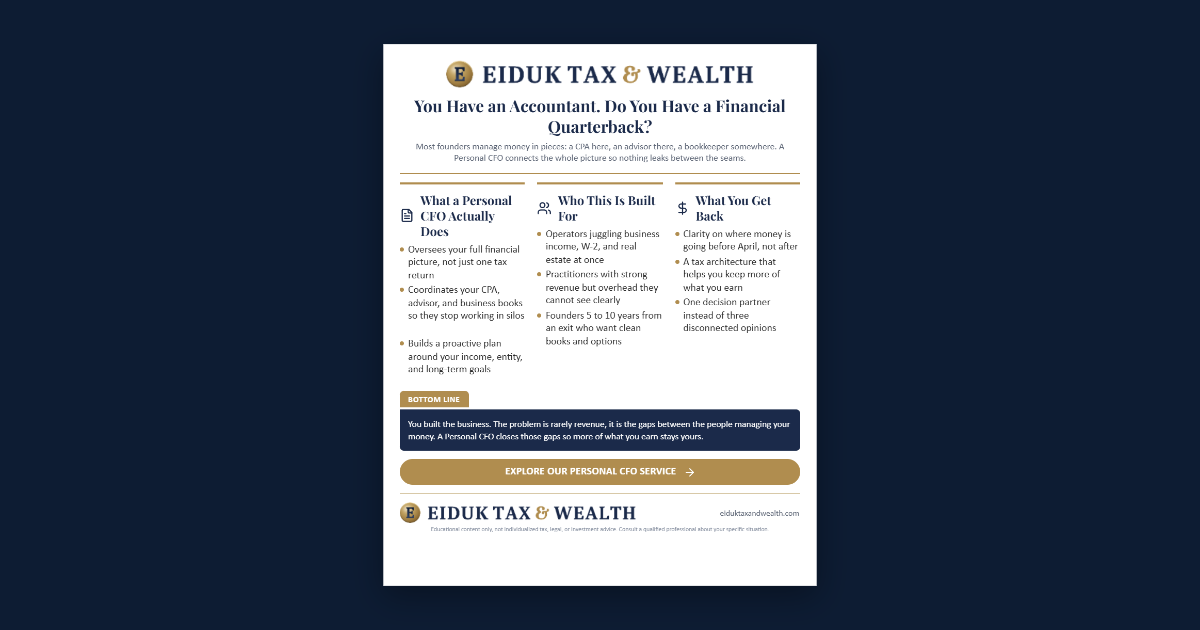
A Personal CFO oversees your full financial picture rather than one slice of it. That means coordinating the professionals you already have so they stop working in silos. Your CPA's tax strategy should inform how your bookkeeper categorizes expenses. Your entity structure should inform how you pay yourself. Your long-term goals should shape all of it. When these are connected, you get one plan instead of three disconnected opinions.
In practice, the work is proactive, not reactive. Instead of a once-a-year tax filing, you get a plan built around how your income actually flows. That might mean reviewing whether your S-corp salary is reasonable and what the split between salary and distributions could look like. It might mean checking whether you're using retirement vehicles that fit your situation, where a solo 401(k) allows employee contributions up to $23,500 in 2025 plus employer contributions on top. It might mean mapping how business income, W-2 wages, and real estate interact before the year ends.
The point is coordination and timing. A single decision partner who sees everything can spot the move that a specialist focused on one lane would never think to raise.
Who This Is Built For
This is not for everyone, and it shouldn't be. It's built for people with enough complexity that the seams actually matter.
Operators juggling multiple income streams at once, business income plus a W-2 plus rental property, feel this most. Each stream has its own rules, and the interactions between them are where planning lives or dies. Practitioners with strong revenue but overhead they can't clearly see are another fit. When you're profitable, taxes quietly become your largest line of overhead, and most people never see it until it's spent.
And then there are founders roughly five to ten years from an exit. If you may sell one day, clean books and a thoughtful structure aren't nice-to-haves. They shape what you walk away with. The decisions that protect a sale get made years ahead, not in the closing room.
What You Get Back
The first thing you get back is clarity before April, not after. Knowing where your money is going while you can still redirect it is a completely different experience than learning about it once the year is closed.
The second is a tax architecture designed around how you actually earn, built to help you keep more of what the business produces. Not a filed return, a structure. The two are not the same.
The third is simpler and easier to underrate: one decision partner instead of three people giving you partial answers. When someone owns the whole picture, you stop being the go-between who has to translate your CPA to your advisor and hope nothing gets lost. That job stops being yours.
The Bottom Line
You built the business. Revenue is rarely the real problem. The problem is the gaps between the people managing your money, because no one is paid to stand above all of it and connect the parts.
A Personal CFO closes those gaps so more of what you earn stays yours. It turns a pile of accurate but backward-looking reports into one forward-looking plan. That's the difference between a historian and an architect, and it's the difference between reacting to your numbers and directing them.
Key takeaways
- Most founders pay four or five financial professionals who never coordinate, and the gaps between them are where money leaks.
- A CPA and bookkeeper look backward at what happened; a Personal CFO works ahead to shape what happens next.
- The role coordinates your CPA, advisor, and books into one proactive plan built around your income, entity, and goals.
- It fits operators with multiple income streams, high-overhead practitioners, and founders five to ten years from an exit.
- You get clarity before April, a tax architecture designed around how you earn, and one decision partner instead of three opinions.
If you're tired of being the translator between people who never talk to each other, let's connect the whole picture. Schedule a conversation with Eiduk Tax & Wealth to see what a Personal CFO relationship could look like for your situation.